The Agent
Ask about what’s on the page, or tell it what to make. It finds footage, tidies your Library, plans a whole job, sets up Generate and changes your edit, and asks before anything costs credits.
The Agent sits at the right of every page in Shotz and in the editor. It sees what you’re looking at: the words on the page, the file open in the Library, the take you’re viewing, what’s in the composer on Generate, or the edit and its timeline in the editor. When you say “this”, it knows what you mean. It also knows your credits, folders, brands, recent projects and what’s generating.
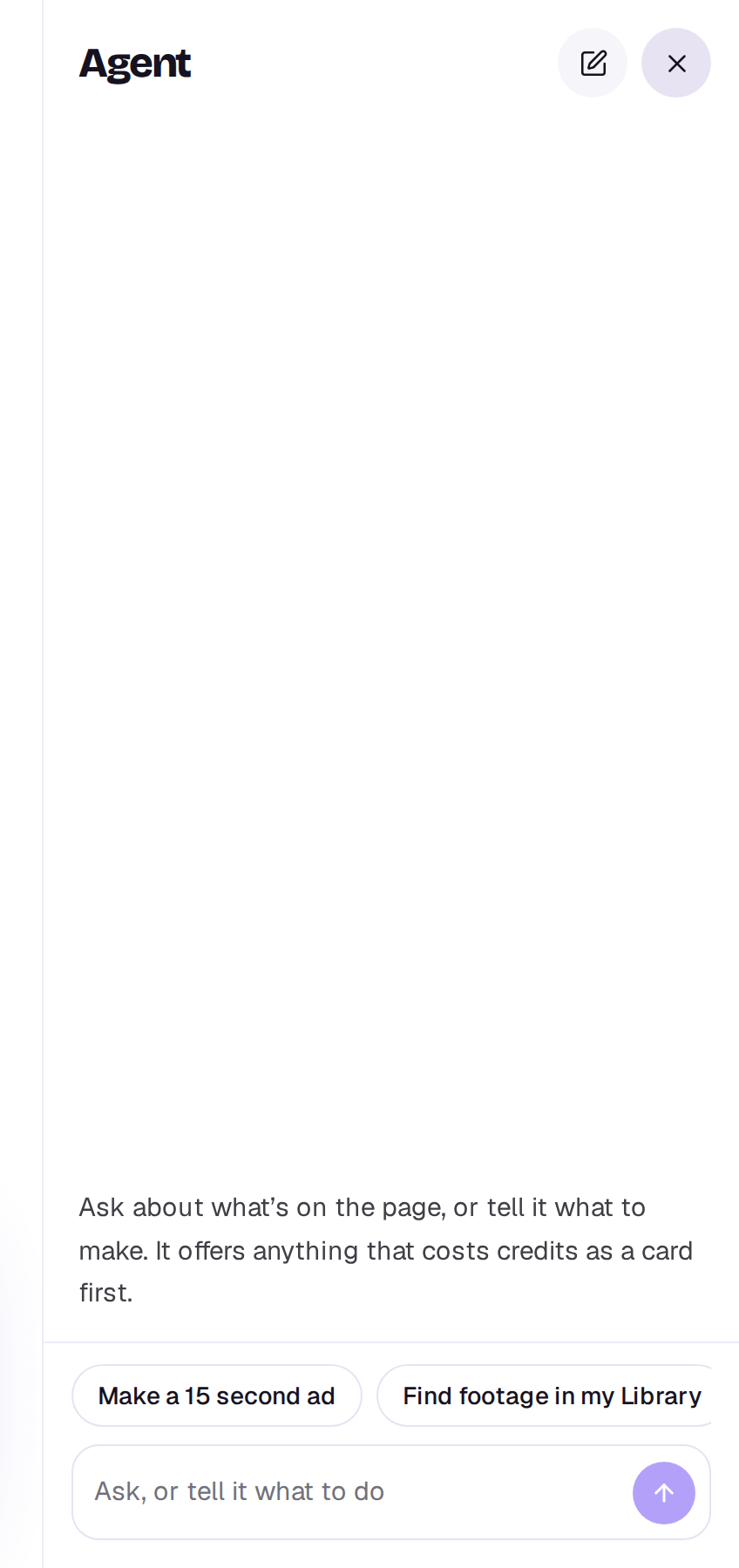
Opening and closing it
Press ⌘J (Ctrl+J on Windows), or click the sparkle in the thin rail at the right of the page. Close it with the × at its top. Open or closed, it stays that way as you move between pages and into the editor. When it’s closed, the rail shows what it’s working on, with a lime dot once something is ready.
On a phone, tap the sparkle among the buttons at the top of the page. In the editor, it’s Agent in the row of tools.
The chip in the box shows what it’s looking at. Choose New chat at the top to start a fresh conversation; your last one is there the next time you open Shotz.
What it does at once
These cost nothing, so it just does them and tells you what it did.
- Find footage. “Where does the red board show up?” It searches the Library, including moments inside your videos, and shows what it found. Choose one to open it.
- Look things up. What’s generating, why a take failed, what’s in a file’s transcript, which projects you have.
- Tidy the Library. Rename a file, rewrite its description or tags, and sort files into folders.
- Start an edit. “Make an edit from my last three clips.” It makes the project with the files on the timeline and opens it.
- Change your edit. In the editor: “Tighten the start”, “Add my latest takes to the end”, “Add a title that says Morning, unfiltered”. It makes the changes on the timeline straight away, as one step, and lists what it did. Choose Undo these to put it back, or use Undo in the top bar.
- Open a page. It takes you there and says where you are.
- Set up Generate. It opens Generate and types the prompt, model, shape and length into the box as you watch. The Generate button glows for a moment, and you press it yourself. Choose Set it up again on its card to redo it.
Plans: anything that costs credits
For a job that spends credits, it shows one card with every step and its price: shots, voiceovers, music, tools like captions or dubbing, fixes and the edit that puts it together. A step can use what an earlier one makes, so “a start frame, then a video from it, a voiceover, music and an edit” is one card.
Press Approve to run it. The button shows the total, or free. Nothing runs before that.
Once approved, the plan runs on its own. You can close the tab or leave Shotz; each step shows where it is and has an Open link when it’s done. Takes land in Generate and the Library as they finish. If a step can’t run, it says why and costs nothing, and the steps that didn’t depend on it still run.
Credits
The Agent never spends credits on its own. If you’re short for the total, Shotz offers a top-up or a plan, the same as anywhere else. Talking to the Agent is free.
What it won’t do
It never deletes anything, shares to the community, invites people or changes billing. It tells you where to do those yourself.
Limits
- Approving a plan and changing edits need you to be an editor of the workspace or the project. If you can only comment, it can answer questions but not make things.
- A plan can have up to 12 steps.
- You can send 30 messages in 10 minutes. After that, give it a little while.
- In the demo workspace it can’t see or run anything; sign in to use it.
A real person in Melbourne will write back, usually within one business day.